




Light therapy has moved from dermatology offices into living rooms fast, and the decision between professional vs home light therapy is no longer simple. You can spend $50 on a handheld device or $200 per session in a clinic, and both claim to deliver the same cellular results. The real difference lives in device power, dosing precision, and how consistently you can follow a protocol. This guide breaks down exactly what separates the two options across seven practical criteria, so you can match the right approach to your skin goals, budget, and lifestyle.
Table of Contents
- Key takeaways
- 1. How to evaluate professional vs home light therapy
- 2. What professional light therapy actually delivers
- 3. What home light therapy devices can and cannot do
- 4. Side-by-side comparison of professional vs home light therapy
- 5. How to decide which light therapy option fits your needs
- My honest take on the professional vs home debate
- Explore Tight Club’s light therapy tools
- FAQ
Key takeaways
| Point | Details |
|---|---|
| Dosing drives results | Wavelength, irradiance, and fluence matter more than device type when determining efficacy. |
| Professional devices offer more power | Clinical equipment delivers higher, calibrated output that reaches deeper tissue layers. |
| Home devices vary widely in quality | Marketing claims often outpace actual biological dosing, so device validation matters. |
| Eye safety applies to both settings | Retinal damage risk is real at both professional and home intensities; protection is non-negotiable. |
| Condition should guide your choice | Acne, photoaging, and hair loss each respond differently, so match therapy to your specific goal. |
1. How to evaluate professional vs home light therapy
Before you compare any two devices, you need a shared framework. The professional vs consumer light therapy comparison falls apart quickly when people focus on brand names instead of the parameters that actually determine whether photons change your cells.
The four criteria that matter most:
- Wavelength: Red light (630 to 680 nm) targets surface skin layers; near-infrared (800 to 850 nm) penetrates deeper tissue. Both professional and home devices use these ranges, but professional systems verify output with calibrated sensors.
- Irradiance and fluence: Irradiance is the power delivered per unit area (mW/cm²); fluence is the total energy dose (J/cm²). Correct wavelength, fluence, and device parameters are the primary efficacy determinants, not the technology itself.
- Treatment consistency: Distance from the device, session duration, and frequency all affect how much energy your tissue actually receives. Varying any of these dilutes your results.
- Device quality and safety standards: Third-party testing, FDA clearance, and CE marking indicate a device has been evaluated. Many consumer products carry none of these.
Pro Tip: Before purchasing any home device, search for the model number plus “irradiance” or “independent testing.” If you find only marketing copy and no third-party data, treat that as a red flag.
Eye safety deserves its own mention here. Retinal damage risk from overexposure is real at both clinical and home intensities. Professional sessions require certified goggles; home users should close their eyes or wear protective eyewear during every session, no exceptions.
2. What professional light therapy actually delivers
Professional light therapy treatment options center on one thing you cannot replicate at home: controlled, verified dosing administered by someone trained to monitor outcomes.
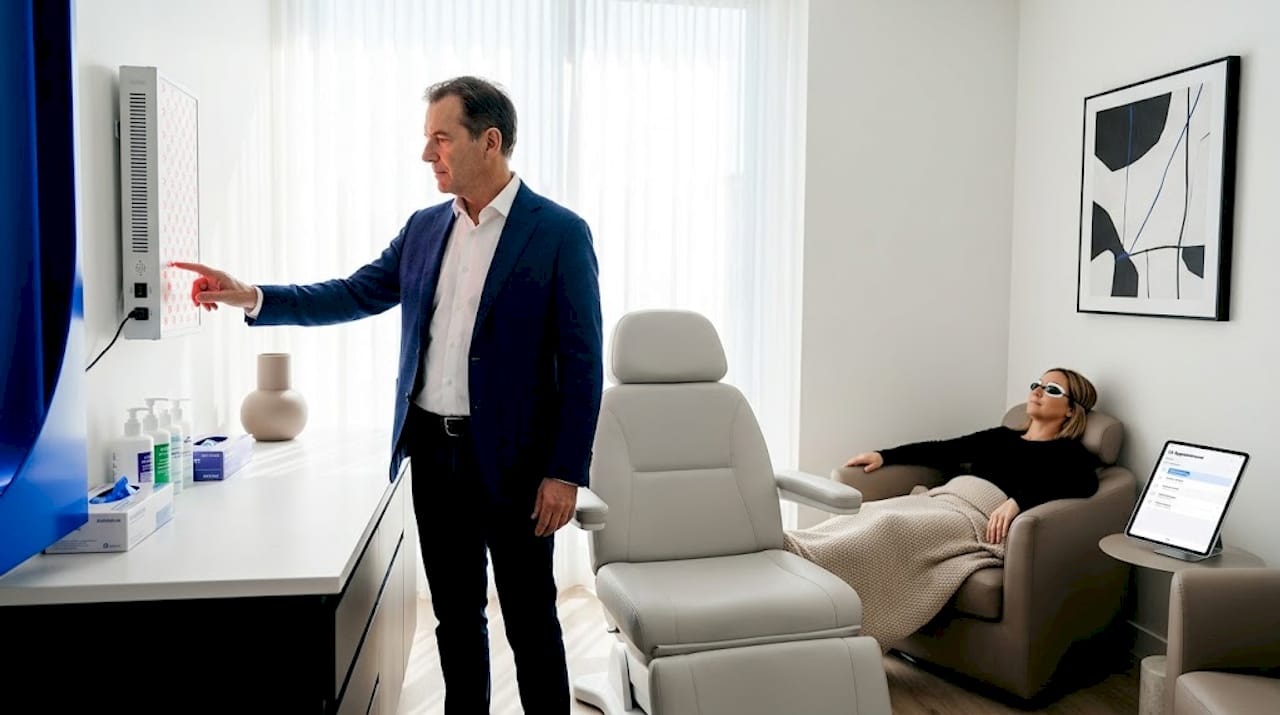
Clinical devices are engineered for consistent output across large treatment areas. Professional LED systems offer higher power, calibrated wavelengths, and more effective treatment than consumer devices, and that gap is not trivial. A professional panel might deliver 100 mW/cm² or more at the skin surface. Most home devices land well below that threshold.
What a professional session typically includes:
- Pre-treatment skin assessment to identify contraindications
- Device positioning at a precise, measured distance from the skin
- Timed sessions calibrated to deliver a specific fluence target
- Eye protection provided and enforced
- Post-treatment monitoring for any adverse reactions
This level of structure matters especially for conditions like inflammatory acne, photoaging, and hair loss. Red light therapy shows moderate efficacy for certain skin disorders, and the outcomes are most predictable when dosing is controlled. For hair restoration specifically, professional guidance is advantageous because scalp coverage and proximity to the follicle are harder to manage without clinical tools.
The cost is the honest downside. A full course of professional treatments for photoaging can run $1,000 to $3,000 depending on the clinic and location. You also need to schedule appointments, travel, and commit to a multi-week protocol. That time and financial investment is not realistic for everyone.
3. What home light therapy devices can and cannot do
Home light therapy benefits are real, but they come with an asterisk. The convenience is genuine. The clinical equivalence is not.
Consumer devices generally provide lower irradiance and fluence and show limited independent validation compared to professional systems. That does not mean they are useless. It means your expectations need to be calibrated to what lower-power devices can reasonably achieve over a longer treatment timeline.
Where home devices perform well:
- Mild to moderate skin texture improvements with consistent daily use
- Maintenance between professional sessions to extend results
- Mood and circadian rhythm support using bright light therapy panels
- Convenient daily wellness routines that do not require clinic visits
Where home devices fall short:
- Deep tissue effects requiring high fluence are harder to achieve
- Treatment area coverage is often smaller, requiring multiple passes
- Marketing claims often fail to reflect effective biological dosing, so the wavelength printed on the box may be accurate while the actual energy delivery is insufficient
Adherence is the other variable. Home users often unknowingly reduce effectiveness by varying device distance or skipping sessions, which dilutes the delivered fluence. A device that works on paper stops working when it sits on a shelf three weeks into a six-week protocol.
Pro Tip: Set a fixed spot in your home for your light therapy device and tie sessions to an existing habit, like your morning skincare routine. Consistency at lower power will outperform sporadic use of a stronger device every time.
4. Side-by-side comparison of professional vs home light therapy
This table gives you a direct look at where each option leads and where it falls short.
| Factor | Professional | Home |
|---|---|---|
| Device power (irradiance) | High, clinically calibrated | Lower, variable by brand |
| Treatment customization | Personalized by trained staff | Self-directed with manual guidance |
| Dosing consistency | Enforced by protocol | Dependent on user adherence |
| Eye safety | Goggles provided and required | User responsibility; often skipped |
| Clinical evidence | Stronger, peer-reviewed support | Limited independent validation |
| Cost per session | $75 to $300+ | Low after initial device purchase |
| Convenience | Scheduled appointments required | Available daily at home |
| Best for | Acne, photoaging, hair loss, deeper tissue | Maintenance, mild concerns, daily wellness |
The biggest efficacy difference arises from dosing and parameter control, not some inherent magic in clinical technology. A well-designed home device used correctly and consistently can produce meaningful results for surface-level concerns. A professional device used with verified protocols produces faster, more predictable outcomes for complex conditions.
Regulatory oversight is another gap worth noting. Professional light therapy equipment operates under FDA clearance requirements for medical devices. Consumer products may carry FDA registration, which is not the same as clearance and does not verify efficacy claims.
5. How to decide which light therapy option fits your needs
The right choice becomes obvious once you get specific about your goal, your timeline, and your budget. Here is a practical framework:
-
Define your primary concern. Acne, photoaging, hair thinning, and general wellness each respond to different protocols. Anchoring your choice to a specific goal is the single most useful thing you can do before spending money on any device or treatment.
-
Assess severity. Mild skin texture concerns or general energy support are reasonable targets for home devices. Persistent inflammatory acne, significant photoaging, or diagnosed hair loss conditions benefit from professional evaluation first.
-
Calculate your real budget. A $300 home device used daily for six months costs less than two professional sessions. A $50 device that delivers inadequate fluence costs you time and money with no return.
-
Consider a hybrid approach. Many people get the best outcomes by starting with a professional course to establish a baseline response, then maintaining results at home between periodic clinical sessions. This is especially true for hair loss, where near-contact treatment to the scalp outperforms distant light sources.
-
Consult before committing. If your concern involves a diagnosed skin condition, a dermatologist or licensed aesthetician can tell you whether light therapy is appropriate and which parameters to target.
My honest take on the professional vs home debate
I’ve spent years watching people make the same mistake with light therapy: they buy a device based on a wavelength number and expect clinical results. What I’ve learned is that the technology is almost never the problem. The dosing is.
In my experience, the professional vs consumer light therapy comparison is really a question of how much control you want over your treatment. Professional settings enforce the variables that home users tend to ignore: distance, timing, and eye safety. That structure produces faster results, especially for conditions like photoaging where fluence targets are specific and non-negotiable.
What I find genuinely encouraging is that the gap between professional and home devices is narrowing. Medical-grade panels designed for home use are entering the market with verified irradiance specs and proper safety features. The problem is that they sit alongside dozens of underpowered devices with identical marketing language, so the burden of research falls on you.
My practical advice: if you are treating a real skin concern, start with at least one professional consultation. Use that session to confirm your skin responds to light therapy and to get a protocol you can follow at home. Then invest in a home device that has third-party irradiance data, not just a wavelength claim. Eye protection is non-negotiable regardless of which path you choose.
— Jess Temple
Explore Tight Club’s light therapy tools
If you are ready to take your light therapy practice seriously at home, Tight Club builds devices specifically for people who want medical-grade cellular results without a clinic appointment.

Tight Club’s panels and portable devices are engineered for real irradiance delivery, not just wavelength marketing. Whether you are working on skin texture, energy, or deeper tissue recovery, their light therapy collection gives you the tools to follow a consistent, effective protocol on your own schedule. Visit the Tight Club home page to explore the full range and find the right device for your specific wellness goals.
FAQ
What is the main difference between professional and home light therapy?
Professional devices deliver higher, calibrated irradiance with verified dosing protocols, while home devices offer convenience at lower power output. The dosing and parameter control gap is the primary efficacy difference between the two.
Is home light therapy effective for skin concerns?
Home light therapy can produce real results for mild to moderate skin concerns when used consistently with a validated device. Effects vary widely by condition and dosing, so matching your device to your specific goal matters.
Do I need eye protection for home light therapy?
Yes. Retinal damage risk applies at home intensities as well as clinical ones. Close your eyes or wear protective eyewear during every session.
Can I use home light therapy for hair loss?
Home devices can support hair growth, but near-contact scalp delivery and consistent dosing are critical for efficacy. Professional guidance is especially useful for diagnosed hair loss conditions.
How do I know if a home device is worth buying?
Look for third-party irradiance data, FDA clearance (not just registration), and independent testing results. Devices that only list wavelength without fluence or irradiance specifications are difficult to evaluate for real-world effectiveness.